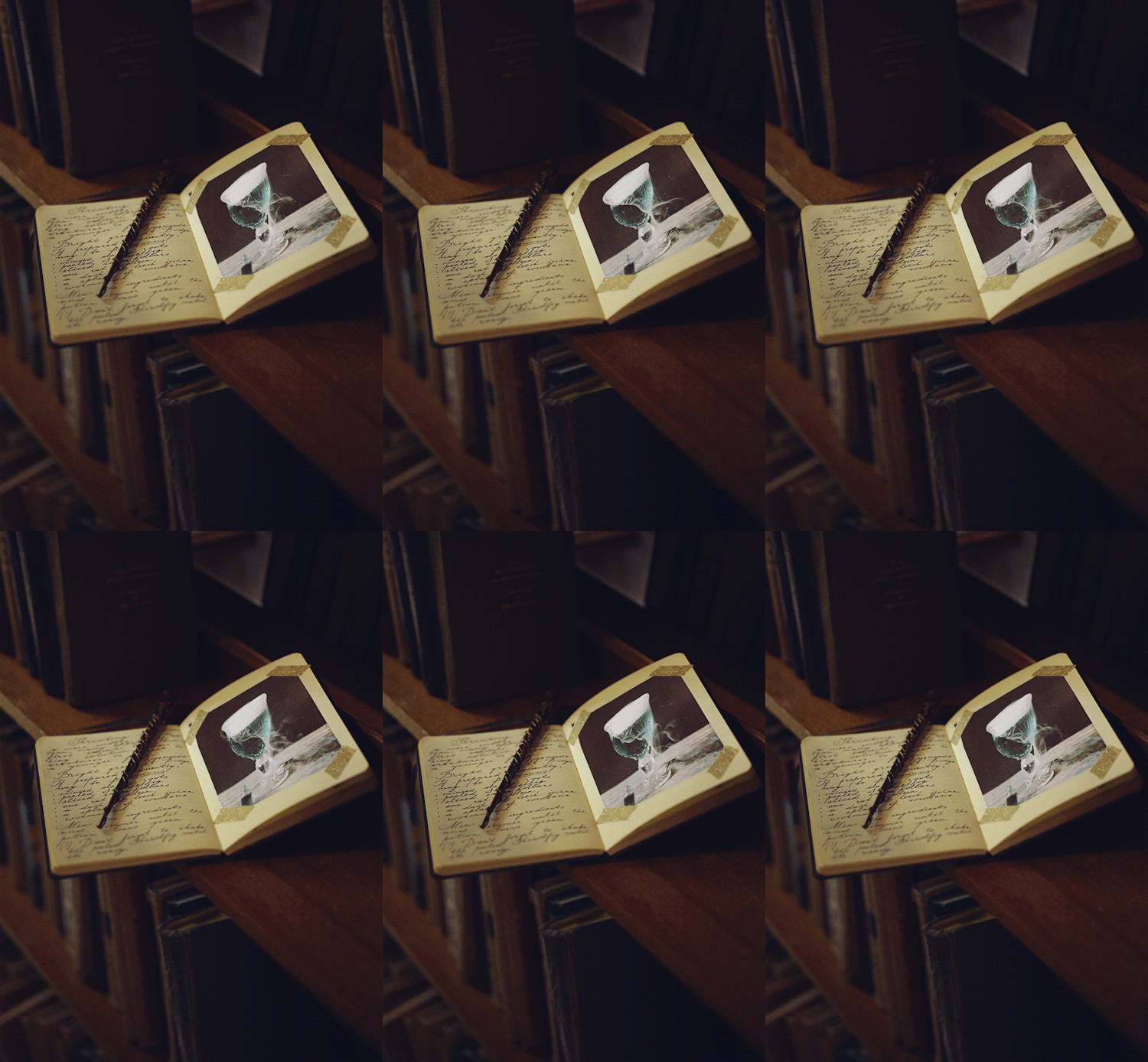
Been doing a lot of work with my grimoire & book of shadows lately and it’s been turning out really nicely so I thought I’d do a little showing off
The grimoire is the fancy little book, where I’m taking more serious notes about my practice, whereas the book of shadows is this funky little box full of notecards of all my spells, quick correspondence reference charts, and tarot spreads that serves a more practical working purpose. The 3rd little book is where I keep my tarot notes.
There is so much washi tape in my life right now and it’s wonderful
I’ve got an ongoing list of things to do with a blank notebook or journal (because I can’t stop buying them), and I’ve pulled out the ones that I think might be of interest to magical, witchy, or pagan types. Hopefully, if you guys find yourselves stuck in front of that first blank page, there’ll be something here to inspire you!
Some of these examples have links or descriptions to further elaborate on what I pictured when I put them on the list, but don’t feel boxed in by any of these! Always feel free to think outside of the box.
🎃
Magical Journal YOU ALREADY KNOW WHAT IT IS :’))
👻
Dream Journal
🎃
Psychic Journal
[1][2] Keep a record of your insights, premonitions and predictions. Be sure to make a note of when you’re right!
👻
Prayer/Chant Journal Even if you don’t write your own, having the ones you enjoy all in one place makes a great reference.
🎃
Meditation Journal [1][2] Journaling can be a form of meditation in and of itself, but you can also keep track of your meditation experiences or just log when you do it. If you’re doing guided meditations, you can list which ones you used as well.
Personal Almanac Make a personal, customized version of the magical almanacs or planners that get released every year.
🎃
Collect Truth Write down the things you agree with. why do you agree? Decide what’s true, or what feels true. If you can, include things that you don’t actually agree with, but you still think are true – that’s a fun thing to contemplate.
👻
Collect Lies I actually started keeping track of the false beliefs I’d either told myself or had been told, and perhaps a little more tricky – things I see others telling each other that I don’t agree with. Feel free to talk about why you have decided these are lies. And look back every now and then to see if you still agree with yourself.
🎃
Formulas Write down your favourite (or even experimental!) recipes for oils, incenses, inks, or whatever else you’ve got going in the cauldron so that you don’t forget how to make them.
Recipe Book Invaluable for a kitchen witch, especially if you’re keeping track of the magical effects of certain recipes!
👻
Book Exercise Journal Almost every book and every course suggests keeping a journal for it to record your progress, do the assignments, et cetera.
🎃
Spelled Book Turn each page into a spell! Rip it out or otherwise engage with the page to use it.
👻
Spirit Dossiers If you work with spirits, keep profiles of their personalities, likes, dislikes, interactions with them, et cetera.
🎃
Charger Book Imbue pages with a magical signature, leave objects on page to charge them.
👻
Book of Spreads I’ve got two spread books – one book has my own spreads, and one book has spreads from other people that I’ve liked. It’s beyond helpful to keep track of these somewhere in case you ever want to use them again, or share them with a friend!
🎃
Good Advice from Other Witches
👻
Altar Photobook Include pictures of your altars for reference, or other altars you loved!
🎃
Correspondences List This is especially useful if you’re trying to develop your own personal correspondences!
Spirit Grimoire Pick a spirit, or group of spirits, and create a grimoire for them
🎃
Shrine Book Make a scrapbook shrine for your gods.
👻
Book Notes Journal Keep notes on the witchy/pagan/etc books you read so you can remember what your thoughts, insights, and problems with them!
🎃
Witchy Transcript In Dedicant: A Witch’s Circle of Fire, Thuri Calafia talks about her witchy transcript: “All the spiritual work I’d done, the meditations I’d used, the rituals I’d written, the books I’d read, everything I could think of pertaining to my spiritual path.” She goes into more detail about what to include in her book, but take the idea and run with it!
👻
Tarot Journal
🎃
Magical Travel Guide Map out your land, neighborhood, et cetera. Make notes of the sacred sites, where spirits live, your local witchy stores, places you do ritual, which grocery store sells fresh basil, where you found the wood you used for your wand, crossroads, and other places of interest. 👻Astral Mapping Similar to the above, but for those of y’all who go Over There.
🎃
Good Ideas I keep a notebook of magical concepts and ideas I find in fiction that I want to figure out how to recreate in real life.
👻
Aesthetic Scrapbook If you’re developing a magical aesthetic [1][2], then keep a book devoted to that! 🎃 Shadow Work Journal [1][2]
👻
(Witchy) Things To Do With A Blank Notebook Keep your own list! When you’re not sure what to do with your next blank notebook, see what stands out on the list and try it out! 🔮
Stuff that is relevant to you. Don’t waste time and effort filling out pages of astrology if you aren’t interested in astrology. If you are never going to use the page for that information, don’t waste the page on it. Don’t be worried about what other witches have in their book. This is your book, not everyone’s. And if you are planning on creating some fantastic book that you’ll pass down to your future witch children, know that the your first one probably isn’t going to be the one you’ll want to pass down anyway. Likely information you once thought was important you’ll later find doesn’t matter to you at all. Let your first book be the one you can mess up and explore in. You need room to learn and grow, not worry about every little detail of what you might be missing.
With that said, here is a list of ideas for what you might want to put in your grimoire. This is a collection of ideas taken from all over. Remember to fearlessly scratch things that you aren’t honestly interested in:
-A book blessing/protection to protect it from wandering eyes
-Your personal pages: a page about you and your goals for the craft, the day you decided to be a witch, your natal chart/zodiac info for you and/or your so/birth tarot cards or birth playing card, your craft name or personal sigil if you have one, any psychic abilities you have
-A page for your personal correspondences: your signature herbs/rocks/scent/sound/animal, your craft name/sigil
-A page for your familiar/s if you have any: their given/secret name, their sigil, info about when you met them and when they left/died, what they helped you with, what they like, how they can be contacted
-A portrait of your shadow self
-A list of your current witch tools, where you got them, whats special about them, how they were consecrated (if they were), etc
-An ancestor page: this could be your family tree, pictures of your deceased, locations of graves, etc
-Info about the plants/animals/rocks in your area
-The wheel of the year, if that’s applicable to you
-Esbat/Sabbat information if that’s applicable (personally I only observe the full moon)
-The monthly moon names if you observe the changing of the moon: you can google and see which ones speak to you, or since they’re outdated you can make up your own (for instance I have a Coyote moon because the coyotes howl outside my house, rather than a Wolf moon)
-Any rites/rituals/songs/poems/pictures/quotes/spells/recipes/etc that are important to you and/or your practice.
-A page to keep a list of all your active spells/wards/enchanted items
-Deity: history/picture/correspondence of any deity you are interested in, for secret witches you can have an altar for them inside your book, entries of your relationship/experience with them, family tree of the pantheon if applicable. Even if you worship an entire pantheon, you don’t need to have a page for everyone in the pantheon. And even if you are a secular witch, you can still make a deity page if you so decide.
-Divination info for the practices you’re interested in: history, correspondence cheat sheet, any spreads you think are important, record your readings, a pendulum board in your book if you’ll use it
-Sigils: how to create/charge, sigils you’ve found helpful
-Meditation, Centering, Grounding and Shielding methods/techniques/symbols/pictures
-Dreamwork: a dictionary of your personal recurring dream symbols, a collection of your dreams written/drawn
-Spiritwork: any spirits you are or have been in contact with and basic information
-Correspondences (remember to think about what your correspondence is and not what some list on tumblr tells you): herbs, rocks and crystals, animals,metals, moon phases, planets, planetary retrograde, colors, directions, your witch tools (this is mostly kitchen tools for me)
Oh, the beautiful working altar! It is a place of magic, with lots of shiny and smelly things on it which make me feel at home. But to the new witch, it can sometimes seem daunting, and even downright scary to look at – almost as if it came right out of some dark fantasy story.
But there’s nothing to be afraid of. Each object on the altar is merely a tool to help visually direct energy. In witchcraft, every tool has its significance and its own symbolism, and it often helps to understand what makes these tools so important. In this series of articles, I will endeavor to lift the shroud of mystery from these tools and assist in helping you understand what each tool is used for, where it comes from, and why we use it.
The Book of Shadows
We’ve all seen various shows that portray witches with various spell books, from the massive tome in Sabrina, The Teenage Witch to the living spell book in Hocus Pocus. It sometimes seems as if the book is as inseparable from witchcraft as the broom, pointed hat, and black cat! However, unlike how they’re portrayed in media, spell books, or Books of Shadows, are unique to each individual, and may have spells, correspondences, references, or may simply be a journal.
Ultimately, the Book of Shadows (hereafter, “BoS”) is a repository of knowledge pertinent to your practice. It’s your reference guide and a measure of your growth as you progress and learn more.
As many experienced witches who teach can attest to, one of the most frequent questions we get is “How to I make a BoS?” or “What do I need to do to get a spell book?” And this question is tricky not because of complexity, but because of its simplicity. So let’s take a look at the different types of BoS, and what could go into them!
Hard Copies, Media Files, and Oral Tradition
Every witch has his or her own aesthetic, preferred method of going about things, and pocketbook. As such, the types of BoS out there vary depending upon the witch! The most stereotypical BoS is the hard copy book. Durable, long lasting, and with a rather gorgeous look, it’s no surprise that from the get go, many of us will reach out to take hold of one of those faux-leather-bound blank journals lining the back wall of Barnes & Noble.
However, when first starting out, jumping straight to these often expensive books is not necessarily practical. The reason for this is that like our practice, our book will likely change and evolve over time to reflect our growth. As such, it isn’t uncommon early on to tear pages out, reorganize, and add pages to incorporate what suits you.
That said, it’s often recommended for the new witch to start simple. And for that there are a couple of options! First is for those who prefer hard copies. In the .gif above, the keen eye might notice that the BoS shown is a simple graph paper notebook. This is not uncommon, and while some may initially fear having a BoS that looks “tacky,” remember that the book will change over time, and as you practice more and find aspects that you know will not be going away anytime soon, you can incorporate them into another more aesthetically pleasing BoS (there’s no rule that says you can’t have more than one! I have several, and for different aspects of my practice).
Far less expensive is the digital BoS. Earlier on, I addressed Technopaganism and how it relates to paganism and witchcraft. In it, I acknowledged that one rather practical aspect to technopaganism is that witches who adopt this philosophy will often set aside files on their devices specifically for witchcraft. For instance, on my computer, I have a folder dedicated to witchcraft, with subfolders that have word files for notes, rites and spells, my blog articles (yes, my articles go in my BoS!) pictures, and correspondences. Though many witches prefer to cast spells and blessings on their BoS and may scoff at the thought of having a digital BoS, remember that in technopaganism, it is not uncommon to bless and cast spells on the device or drive that has the files in question, just as one would bless and cast a spell on a physical book.
Some witches who like the digital aspect even create public BoS’s here on Tumblr! Blogs are often a great repository for spells and notes regarding witchcraft, so it’s good to keep your eyes peeled for a good BoS page!
Lastly, there is another type of BoS that often goes unrecognized and treated less carefully because it’s not a physical object, and that’s oral tradition. Many of our ancient ancestors who did not have a written language passed their traditions, spells, and rites down to one another through strictly oral means. And some who had a written system maintained a mostly oral tradition as well (take, for instance, the Celts and Norse – both had written systems but maintained their traditions orally). The message here is that if you don’t feel that having a BoS is necessary or desired, you are not a lesser witch for it. Even today, some families maintain an oral system, passing their faith and traditions down from one generation to the next with the spoken word.
Compilations, Dreams, and Magic
So we’ve seen the different formats used for a BoS. But… what goes into it? Well, the simple answer is anything you want! And much to the frustration of many new witches, that’s exactly the answer they get. So let’s take a look at what commonly goes into a BoS, and how it can be varied.
Spells: This one’s the most common subject. After all, many witches prefer a repository of their successful spells for future reference. So many include a section in their books dedicated specifically to spells. (If the book were dedicated solely to spells and rites, it is often referred to as a grimoire instead of a BoS, though this is mostly a matter of preference).
Rites: This varies from tradition to tradition, as some partake in full rites whereas others don’t. But a section devoted to rites will likely include rituals for the Wheel of the Year, other holidays and sabbats, esbat (lunar) rites, and even initiation and dedication rites for covens.
Correspondences: If you rely heavily on correspondences, be they for astrology, color, runes, plants, or otherwise, it is often recommended to have a reference or resource where you can look up the proper correspondences for your tradition. As such, many witches who work with such correspondences will have a section dedicated appropriately.
Recipes: Giggle as you may, but kitchen witches often joke about their BoS being a cookbook. And some legitimately have a cookbook as a BoS. Regardless, those who work magic into their cooking may prefer to have some good go-to recipes on hand! Need an example? One of my books is dedicated solely to Foodie Friday recipes, and I do consider it to be a BoS!
Journals: Whether it be a dream journal, or a diary, there are many witches out there who incorporate their journals into their BoS. This has a couple of benefits: the first is that it is an excellent way of tracking growth; the second is that it provides a cross reference, so if you forget something in another section of your BoS, you could have it in your journal. It is also an excellent way of providing a personal narrative regarding your development and relationship to the gods, if that is part of your path.
Notes: Let’s face it, as a new witch (or even an experienced witch), you probably do a lot of note-taking, jotting down new information or spells or philosophies for your craft. The BoS is an excellent repository for these scribbles!
There is plenty more that can be added to a BoS, but these are the most common subjects. Is there a proper order to have in a BoS? Only if you feel you need one. However, for me, I have found that if I were to establish a table of contents in my BoS, it would be rendered null rather quickly as I add and remove subjects. Instead, sticky notes, tabs, bookmarks, or ribbons can be used to separate sections so that you can easily page through your book!
Custom Made!
Many new witches might see a lot of those rather gorgeous home-made books out there. Though your book need not be pretty to be functional, it is encouraged to make your book your own. If you’re artistically inclined, bend that toward your book and create a BoS that doubles as a masterpiece! Some will create wood bindings, while others may simply draw and decorate the edges of their pages. It can be as complicated as that, or as simple as adding a ribbon with a crystal on it. The book is yours, so do what you’d like with it!
So Josh, what kinds of BoS do you have?
Well, I have several. The first is my aforementioned digital BoS. Though I don’t use it for spellcasting, it is a backup repository of my notes and articles, as well as a place where I can write out new spells and rites as needed before printing them for coven work (because my handwriting isn’t exactly the easiest for others to read). The second is the aforementioned Foodie Friday Notebook. The notes and recipes that I write down are later shared with all of you, and I keep it all for future reference and for my own work! Third is my coven BoS. This is a hard cover blank journal in which I write down all of the rites and spells that we do together, as well as where I write down any notes that may be pertinent to our practice. Fourth is my personal BoS, which is a faux-leather-bound journal in which I write my finalized aspects to my practice.
It’s likely that I could end up with new books in the future, and my BoS’s will continue to change over time!
How can I make my own BoS?
Use everything we’ve covered above as a guideline in crafting your personal BoS. Remember that if affordability is an issue, you can always start small and later on build up to something you’d prefer. Whether it be a digital file, a spiral bound notebook, or a blank journal, remember that your BoS is your reflection and repository! Treat it with care and as much respect as you would any other tool for the craft!
(This post is inspired by a baby witch in our Coven @andtrickfucker)
Starting as up as a witch can often be overwhelming and confusing. We’ve all been there when we sit with our grimoire, a pen out as we stare down at an empty piece of paper, a small (hypothetical) tear rolling down our face as we attempt to write something down, only to discover that we have no idea what to do and where to start. As two witches who have most definitely struggled with this before we decided that it would be very important for us to make a list to help you all out!
Firstly, we’d start out with the very basics of witchcraft!
(Obviously according to whatever craft you do but lets just assume the general craft for now and work with what we’ve got.)
☆ Ask yourself what path you follow, what sort of craft do you practice? Is there anything specific you what to jot down about your craft? If so, note it at the start of your grimoire! It could be super helpful to you in the future. ☆ If you’re not an atheistic witch then you can also mention what deities you worship and those in their pantheon (unless you’re an animistic witch!)
☆ You could write about the elements and moon cycles, as some witches find this to be very important to them! ☆ Do you have some crystals that are your favourite to work with? Write them down, and what you use them for! (We have some information about this here!) ☆ You can even write down how to charge and cleanse them and even how you intended to use them in spells! ☆ Do you use a lot of herbs and plants? Write them down too! If you’re fairly arty like us don’t be afraid to do a little sketch of whatever you’re writing! ☆ Like crystals, you could write down when or how to use them. It doesn’t have to be detailed or complex, just do it in a way that you’ll remember or understand! ☆ Candles are often important too, so (even if you’re not particularly interested in candle magic) it might be helpful to have them in there as well. If you write their correspondences down too, it’ll save you a bunch of time looking through the internet for their meaning, trust me.
Do you practice divination and spirit work?
☆Tarot references can be helpful, especially if you don’t have a book to learn or work from! You could even write down the results of your tarot readings, keeping a note of exactly what you’ve been pulling and how you’ve been doing reading wise!(You might wanna ask for permission if you’re going to write about readings you’ve done on others though!) ☆ How to use a crystal ball, if you have one! ☆ How to sense auras and what they mean. ☆ If you use rune stones it might be helpful for you to write down their names and meanings!(Wilde uses runes a lot and had to do this because she gets confused and forgets the meanings of runes almost 24/7) Again, if you want, you can write about the outcomes of your readings. ☆ How to use a pendulum.
Spell work
☆ An inventory of different salts, herbs and crystals; branching away from your most used and favourites! you never know, one might catch your eye!
☆ Different types of spells (clearly)! We find it helps if you split them up categorically but if you don’t want to then don’t do it! Write down your hexes, curses, charms and your run of the mill spells, especially ones that you’ve written yourself!
Miscellaneous
☆ How to make sigils and the sigils themselves! ☆ If you use other peoples sigils write them down with there meanings too, that way you don’t forget or you don’t use a sigil that you wanted to work with later on! ☆ Notes on how you feel or your specific emotions. This is important because emotions can obviously influence and change the way spells and sigils work! ☆ Do you use astrology? Write down the zodiac signs and their correspondences, along with the stars, the planets and everything in between! ☆ How to meditate and the benefits of meditation. ☆ Types of salts and their purposes. ☆ How to make different types of oils. ☆ How to make different types of waters! ☆ How to make your own candles. ☆ How to make your own salves! ☆ A magical cookbook!
Remember! Your grimoire doesn’t have to look perfect (Quinn’s is an absolute state) As long as it holds the information you need and as long as you can read it that’s the only thing that matters!
As suggested by @maikawethiel make a digital version to keep with you at all times! You can do this via word online, google documents or even evernote which you can then download onto a portable device! This can be handy for emergancy situations too!
I know this isn’t everything you could possibly put in your grimoire however feel free to reblog and add to it!!
for those of you that do not know, a grimoire is a book/collection of information regarding your craft. these are just basic topics you can mention, however, your path is your path and it is beautiful regardless. another disclaimer: your grimoire doesn’t have to be flashy and ancient looking. it can be a composition notebook. it can be a collection of paper held together by staples. as long as it is functional, it just as valid. because you put the time and the positive energy into making it.
grimoire ideas
🌞your beliefs 🌙any daily rituals 🌞written spells 🌙moon phases 🌞info on herbs 🌙herb correspondances 🌞chakras 🌙auras 🌞color correspondances 🌙divination 🌞moon water 🌙sun water 🌞mythology 🌙tea magic 🌞constellations 🌙dream log 🌞a list of elements 🌙essential oils 🌞oil correspondences 🌙spirits 🌞crystal correspondences
remember, this is just a list of things you can write! there are far more things. if anyone would like to suggest something to add to the list, just let me know <3. much love, –mikey




 teakepp