Unpopular opinion but unless you’re a gay man, don’t use the gay flag. It’s not a “pride flag”, it’s not an “LGBT flag”, it is a GAY flag, for men who love men and only men, and it makes no sense for someone who isn’t a gay man to use it.
this is a really terrible and ignorant take, the original flag was designed to show what brings us together as a community
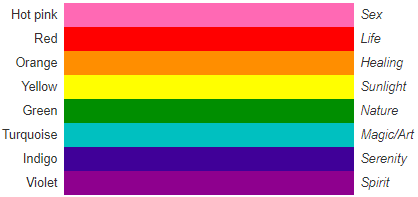
the pink was removed due to shortage of fabric, and indigo-turquoise was replaced with a royal blue when they wanted the flag to have two equal halves. 30 people with varying identities hand-dyed and hand-stitched the first pride flag together, the only reason it was called the “gay flag” (and the “gay community” and “gay pride” for that matter) is because everything fell under “gay” at the time, including being trans.
if you want to make us a flag then go for it, but don’t go around ignoring the rainbow flag’s history.
“At this point, the pink triangle was the symbol for the gay movement. But it represented a dark chapter in the history of same-sex rights. … We all felt that we needed something that was positive, that celebrated our love.
I thought a gay nation should have a flag too, to proclaim its own idea of power.As a community, both local and international, gay people were in the midst of an upheaval, a battle for equal rights, a shift in status where we were now demanding power, taking it. This was our new revolution: a tribal, individualistic, and collective vision. It deserved a new symbol.
A Rainbow Flag was a conscious choice, natural and necessary. The rainbow came from earliest recorded history as a symbol of hope. In the Book of Genesis, it appeared as proof of a covenant between God and all living creatures. It was also found in Chinese, Egyptian and Native American history. A Rainbow Flag would be our modern alternative to the pink triangle. Now the rioters who claimed their freedom at the Stonewall Bar in 1969 would have their own symbol of liberation.”
WWII gay love letters are honestly the most beautiful, heartbreaking, and anxiety inducing things I’ve ever read, hands down.
This poor guy is about to have a nervous breakdown and almost outed himself to his fellow pilots. Sweetheart…. no….
“All the lads are guessing where we are going, darling. I only know I am going away from the man I love, the one and only you old darling. But I know I will come back darling to you, and it will only be a dream darling.”
Oh my god they’re so in love….
“You don’t know how much I miss you Monty. I love you darling so think good of me my sweetheart. All my love and a merry Xmas.”
So this gent right here is the Monty that received the letters posted above.
And here’s Ralph, the man who had been sending them:
@my-darling-boy I don’t think it’s a picture of Monty at all, can you correct this post darling please?
Whoops, if it’s not a correct picture I apologize! I was referencing a book when I made this post months ago, and could easily have been mistaken!
No problem my friend! Those two are actually very little documented and Alastair owns the most complete but out of stock book about them. I’m sure he’ll add the correct picture soon but don’t worry about it, errare humanum est!
Ah yes, I agree, there is unfortunately very little documentation of these two!
This is actually Monty, and to my knowledge, there are only 3 pictures of him that have been released to the public in the book A Class Apart by James Gardiner.
1) Monty during WWI, photographed 1917
2) Monty is in the center, most likely taken post WWI
3) Monty in a car, visible on the right, most likely taken post WWI
The book, like my boyfriend says, is no longer able to be purchased unless you’re willing to pay a couple hundred for one of the limited copies sold through Amazon :’) I was lucky enough to find a copy on the web for only $15 from a small bookstore in Oregon that was clearing out their inventory and getting rid of the last copy!
And, in the book, next to the photo you have posted of Ralph, this photograph is also to be found! 😛
Since I see no one online anywhere mentioning the details of the book and more on their life together, feel free to message me for any further info on these two and I’ll see if I have an answer!
If you can find the book at a decent price, it is definitely worth the buy; there is much more info about their domestic life as they lived together, plenty more photos of Ralph, Monty’s photography, letters between Monty and Ralph (and unfortunately, letters between Monty and a couple of other boys while Ralph was away during WW2), as well as age progression photos of Ralph that I do find endearing!
my night manager (who is a gay man) and i sometimes sit down and exchange stories and tidbits about our sexuality and our experiences in the queer cultural enclave. and tonight he and i were talking about the AIDS epidemic. he’s about 50 years old. talking to him about it really hit me hard. like, at one point i commented, “yeah, i’ve heard that every gay person who lived through the epidemic knew at least 2 or 3 people who died,” and he was like “2 or 3? if you went to any bar in manhattan from 1980 to 1990, you knew at least two or three dozen. and if you worked at gay men’s health crisis, you knew hundreds.” and he just listed off so many of his friends who died from it, people who he knew personally and for years. and he even said he has no idea how he made it out alive.
it was really interesting because he said before the aids epidemic, being gay was almost cool. like, it was really becoming accepted. but aids forced everyone back in the closet. it destroyed friendships, relationships, so many cultural centers closed down over it. it basically obliterated all of the progress that queer people had made in the past 50 years.
and like, it’s weird to me, and what i brought to the conversation (i really couldn’t say much though, i was speechless mostly) was like, it’s so weird to me that there’s no continuity in our history? like, aids literally destroyed an entire generation of queer people and our culture. and when you think about it, we are really the first generation of queer people after the aids epidemic. but like, when does anyone our age (16-28 i guess?) ever really talk about aids in terms of the history of queer people? like it’s almost totally forgotten. but it was so huge. imagine that. like, dozens of your friends just dropping dead around you, and you had no idea why, no idea how, and no idea if you would be the next person to die. and it wasn’t a quick death. you would waste away for months and become emaciated and then, eventually, die. and i know it’s kinda sophomoric to suggest this, but like, imagine that happening today with blogs and the internet? like people would just disappear off your tumblr, facebook, instagram, etc. and eventually you’d find out from someone “oh yeah, they and four of their friends died from aids.”
so idk. it was really moving to hear it from someone who experienced it firsthand. and that’s the outrageous thing – every queer person you meet over the age of, what, 40? has a story to tell about aids. every time you see a queer person over the age of 40, you know they had friends who died of aids. so idk, i feel like we as the first generation of queer people coming out of the epidemic really have a responsibility to do justice to the history of aids, and we haven’t been doing a very good job of it.
Younger than 40.
I’m 36. I came out in 1995, 20 years ago. My girlfriend and I started volunteering at the local AIDS support agency, basically just to meet gay adults and meet people who maybe had it together a little better than our classmates. The antiretrovirals were out by then, but all they were doing yet was slowing things down. AIDS was still a death sentence.
The agency had a bunch of different services, and we did a lot of things helping out there, from bagging up canned goods from a food drive to sorting condoms by expiration date to peer safer sex education. But we both sewed, so… we both ended up helping people with Quilt panels for their beloved dead.
Do the young queers coming up know about the Quilt? If you want history, my darlings, there it is. They started it in 1985. When someone died, his loved ones would get together and make a quilt panel, 3’x6’, the size of a grave. They were works of art, many of them. Even the simplest, just pieces of fabric with messages of loved scrawled in permanent ink, were so beautiful and so sad.
They sewed them together in groups of 8 to form a panel. By the 90s, huge chunks of it were traveling the country all the time. They’d get an exhibition hall or a gym or park or whatever in your area, and lay out the blocks, all over the ground with paths between them, so you could walk around and see them. And at all times, there was someone reading. Reading off the names of the dead. There was this huge long list, of people whose names were in the Quilt, and people would volunteer to just read them aloud in shifts.
HIV- people would come in to work on panels, too, of course, but most of the people we were helping were dying themselves. The first time someone I’d worked closely with died, it was my first semester away at college. I caught the Greyhound home for his funeral in the beautiful, tiny, old church in the old downtown, with the bells. I’d helped him with his partner’s panel. Before I went back to school, I left supplies to be used for his, since I couldn’t be there to sew a stitch. I lost track of a lot of the people I knew there, busy with college and then plunged into my first really serious depressive cycle. I have no idea who, of all the people I knew, lived for how long.
The Quilt, by the way, weighs more than 54 tons, and has over 96,000 names. At that, it represents maybe 20% of the people who died of AIDS in the US alone.
There were many trans women dying, too, btw. Don’t forget them. (Cis queer women did die of AIDS, too, but in far smaller numbers.) Life was and is incredibly hard for trans women, especially TWOC. Pushed out to live on the streets young, or unable to get legal work, they were (and are) often forced into sex work of the most dangerous kinds, a really good way to get HIV at the time. Those for whom life was not quite so bad often found homes in the gay community, if they were attracted to men, and identified as drag queens, often for years before transitioning. In that situation, they were at the same risk for the virus as cis gay men.
Cis queer women, while at a much lower risk on a sexual vector, were there, too. Helping. Most of the case workers at that agency and every agency I later encountered were queer women. Queer woman cooked and cleaned and cared for the dying, and for the survivors. We held hands with those waiting for their test results. Went out on the protests, helped friends who could barely move to lie down on the steps of the hospitals that would not take them in — those were the original Die-Ins, btw, people who were literally lying down to die rather than move, who meant to die right there out in public — marched, carted the Quilt panels from place to place. Whatever our friends and brothers needed. We did what we could.
OK, that’s it, that’s all I can write. I keep crying. Go read some history. Or watch it, there are several good documentaries out there. Don’t watch fictional movies, don’t read or watch anything done by straight people, fuck them anyway, they always made it about the tragedy and noble suffering. Fuck that. Learn about the terror and the anger and the radicalism and the raw, naked grief.
I was there, though, for a tiny piece of it. And even that tiny piece of it left its stamp on me. Deep.
2011
A visual aid: this is the Quilt from the Names Project laid out on the Washington Mall
I was born (in Australia) at the time that the first AIDS cases began to surface in the US. While I was a witness after it finally became mainstream news (mid-85), I was also a child for much of it. For me there was never really a world Before. I’m 35 now and I wanted to know and understand what happened. I have some recommendations for sources from what I’ve been reading lately:
And the Band Played On: Politics, People and the AIDS Epidemicby Randy Shiltsis a seminal work on the history of HIV/AIDS. It’s chronological and gives an essential understanding of all the factors that contributed to the specific history of the virus’ spread through the US and the rest of the world, the political landscape into which it landed (almost the worst possible)*. Investigative journalism and eyewitness account. Shilts was himself an AIDS casualty in 1994.
Larry Kramer is a pretty polarising figure and he had issues with the sexual politics of gay New York to begin with (see: Faggots) but he’s polarising for a reason: he’s the epidemic’s Cassandra. Reports from the Holocaustcollects his writings on AIDS.
I don’t think I can actually bring myself to read memoirs for the same reason I can’t read about the Holocaust or Stalinist Russia any more. But I have a list:
Read or watchThe Normal Heart. Read or watch Angels in America. Read The Mayor of Castro Streetor watchMilk. Dallas Buyers Clubhas its issues but it’s also heartbreaking because the characters are exactly the politically unsavory people used to justify the lack of spending on research and treatment. It’s also an important look at the exercise of agency by those afflicted and abandoned by their government/s, how they found their own ways to survive. There’s a film of And the Band Played Onbut JFC it’s a mess. You need to have read the book.
Everyone should read about the history of the AIDS epidemic. Especially if you are American, especially if you are a gay American man. HIV/AIDS is not now the death sentence it once was but before antiretrovirals it was just that. It was long-incubating and a-symptomatic until, suddenly, it was not.
Read histories. Read them because reality is complex and histories attempt to elucidate that complexity. Read them because past is prologue and the past is always, in some form, present. We can’t understand here and now if we don’t know about then.
*there are just SO MANY people I want to punch in the throat.
They’ve recently digitized the Quilt as well with a map making software, I spent about three hours looking through it the other day and crying. There are parts of it that look like they were signed by someone’s peers in support and memoriam, and then you realize that the names were all written in the same writing.
That these were all names of over 20 dead people that someone knew, often it was people who’d all been members of a club or threatre group.
As well, there are numerous people who were buried in graves without headstones, having been disenfranchised from their families. I read this story the other day on that which went really in depth (I would warn that it highlights the efforts of a cishet woman throughout the crisis): http://arktimes.com/arkansas/ruth-coker-burks-the-cemetery-angel/Content?oid=3602959
I’ve had several conversations recently with younger guys for whom this part of our history isn’t well known. Here are some resources for y’all. Please, take care of one another.
this is so hard to read or even think about but… it’s so important. it’s so important to understand just the …overwhelming SCALE of this. how many people died while the government did NOTHING.
Reblogging for pride
Never forget your fallen. Your people were nearly annihilated in an epidemic. Never forget how lucky we are, never forget how they tried to let us die.
I shadowed a doctor who was a resident during the AIDS crisis. He volunteered to work on the AIDS floor. It was volunteer unlike most areas, because medical staff were afraid of catching it and they still didn’t understand it.
He said it was one of the word things he had ever seen, a whole floor of young men dying. Every week the obituaries would come out and there would be dozens of names of been in their 20s and 30s. They never said what that died of, but you could tell.
Many of the Republicans in power now were around back then, and they laughed at the idea of a queer plague.
First, thank you for coming to us, you didn’t come off as rude at all.
Well, we don’t have a tag or masterpost, but I can create a list of articles we have up at this point (May 14, 2018) that focuses on queer subjects from before Stonewall.


 teakepp